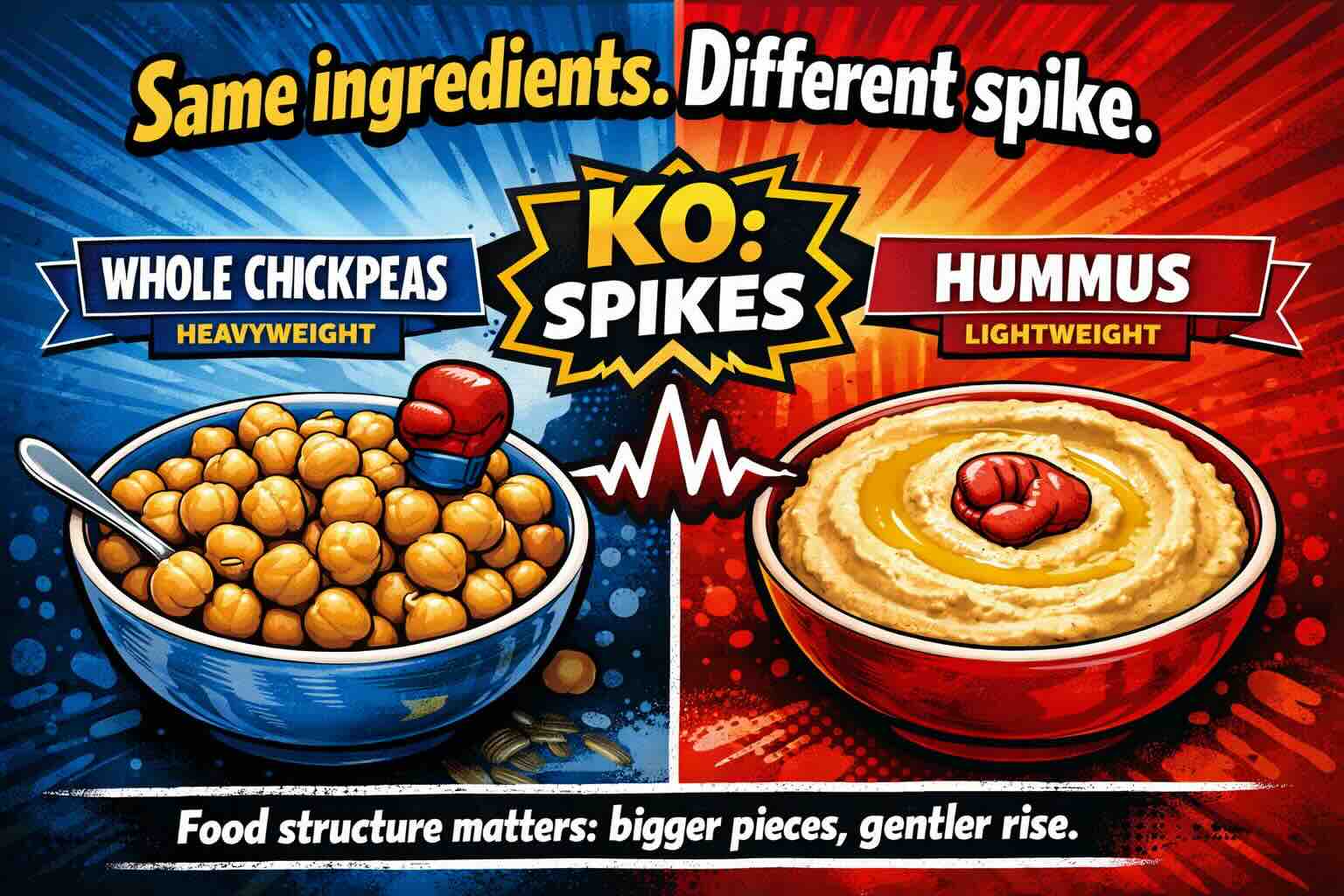
Why Grain Size Matters: Insulin, Glucose, and Your Health
I am trying to optimize my nutrition to reduce insulin spikes and also looking for ways in could make small changes in my life to improve my health.
So I asked Claude Opus 4.5 to help me with this. Here’s the blogified final result. Hope it helps.
ALSO THIS IS AI GENERATED AND I AM NOT A DIABETIC OR A DOCTOR SO PLEASE TAKE IT WITH A GRAIN OF SALT.
Here you go:
The physical form of carbohydrate-rich foods often matters more than their fiber content. A growing body of peer-reviewed research demonstrates that grain particle size, cellular integrity, and food matrix structure profoundly influence postprandial glycemic and insulin responses—with differences of 30-50% in blood glucose and 40-50% in insulin between intact and disrupted versions of identical foods. This evidence suggests that conventional dietary guidance focusing primarily on “whole grain” labeling misses a critical dimension: the degree to which processing has preserved or destroyed the plant’s original cellular architecture.
The implications are substantial for diabetes management and metabolic health. Clinical trials show that simply choosing less-processed forms of the same whole grains—steel-cut oats instead of instant, intact legumes instead of flour—can produce glycemic improvements comparable to pharmaceutical interventions, without changing overall carbohydrate intake.
Cell walls act as natural “starch capsules”
The fundamental mechanism underlying particle size effects centers on plant cell wall integrity as a physical barrier to digestive enzymes. In a landmark 2015 randomized controlled trial published in the American Journal of Clinical Nutrition, Edwards and colleagues fed healthy ileostomy participants wheat porridge made with either coarse (2mm) or fine (<0.2mm) particles, each providing 55g of starch. The results were striking: coarse particles produced 33% lower blood glucose, 43% lower insulin, and 50% lower GIP (glucose-dependent insulinotropic polypeptide) compared to the finely ground version.
Microscopic examination of the ileal effluent revealed the key mechanism—intact plant cell walls survived transit through the entire small intestine, with starch digestion occurring progressively from the particle periphery toward the center. A single intact cell wall proved sufficient to protect encapsulated starch from α-amylase attack. This finding, replicated by research groups at King’s College London, Monash University, and the Quadram Institute, establishes that cell wall encapsulation—not fiber content per se—mediates much of dietary fiber’s metabolic benefit.
The protective effect differs by plant type. Legumes possess thick Type I cell walls rich in pectic polysaccharides, making them particularly resistant to enzymatic penetration. In controlled digestion studies by Dhital et al. (2016) published in Food Function, intact legume cells showed only 2-3% starch digestion compared to 45-50% when cells were mechanically broken. Even after thermal processing at 95°C, isolated legume cells remained impervious to α-amylase—only mechanical force sufficient to rupture cell walls released the starch for digestion.
Whole legumes versus processed forms show dramatic differences
Recent clinical trials directly comparing intact legumes to their milled counterparts confirm the magnitude of these effects in human subjects. A 2025 study by Winham and colleagues in Foods examined glycemic responses in adults with type 2 diabetes and metabolic syndrome after consuming whole lentils, whole peas, or their flour equivalents (matched for available carbohydrate at 50g).
The results demonstrated clear superiority of intact forms:
- In diabetic participants, whole lentils produced a glucose iAUC of 73.4 mmol×min/L compared to 150.9 for pea flour—approximately 50% lower during the critical 0-60 minute window (P=0.004)
- At 30 minutes post-consumption, whole lentils and peas produced significantly lower blood glucose than pulse flours (P=0.001 and P=0.012, respectively)
- The control glucose beverage produced the highest response at 217.5 mmol×min/L, with whole pulses achieving 66% reduction versus only 30% reduction for flours
A 2024 randomized crossover trial published in Food Research International specifically examined the hummus matrix, comparing hummus prepared from intact chickpea cells (ICC) versus ruptured chickpea cells (RCC). Despite identical macronutrient composition, the intact-cell hummus produced significantly lower insulin concentrations (P<0.02) and lower GIP (P<0.03). In vitro digestion confirmed slower starch hydrolysis from intact cells at 90 minutes, with microscopy showing preserved cellular structures.
A systematic review by Clarke et al. (2022) in Nutrients synthesized 18 studies on lentil consumption and established that whole or pureed lentils reduce blood glucose AUC by 45-68% compared to high-GI controls, while lentil flour incorporated into muffins achieves only ~25% reduction—still beneficial, but roughly half the effect of intact forms.
Grain processing dramatically alters glycemic impact
The effect of processing on cereal grains follows similar patterns. A 2015 systematic review by Tosh and Chu in the British Journal of Nutrition analyzed 72 glycemic index measurements across more than 20 publications on oat products. The GI values demonstrated clear processing effects:
| Oat Product | Mean GI | Processing Level |
|---|---|---|
| Large-flake oats | 53 ± 2.0 | Minimal |
| Steel-cut oats | 55 ± 2.5 | Minimal |
| Muesli/granola | 56 ± 1.7 | Low |
| Quick-cooking oats | 71 ± 2.7 | Moderate |
| Instant oatmeal | 75 ± 2.8 | High |
Quick-cooking and instant oats produced significantly higher GI than large-flake oats (P<0.001), representing an increase of 18-22 GI points—sufficient to reclassify the same grain from “low GI” to “high GI” based solely on processing.
A 2021 meta-analysis by Musa-Veloso et al. in the Journal of Nutrition quantified the dose-response relationship between oat processing and metabolic outcomes across 16 comparisons. Intact oat kernels reduced glucose AUC by 45.5 mmol×min/L and insulin by 4.5 nmol×min/L compared to refined grain controls. Thick oat flakes (>0.6mm) showed smaller but significant reductions. Critically, thin/quick/instant flakes (≤0.6mm) showed no significant effect—processing had eliminated the metabolic benefit entirely.
The 2020 Reynolds study in Diabetes Care tested four wholegrain breads varying in particle size in 15 adults with type 2 diabetes. Bread containing the largest particles (40% flour + 30% kibbled + 30% intact grain) produced a glucose iAUC of 376 mmol×min, compared to 641 for 100% roller-milled wholegrain flour—a 41% reduction. The inverse linear relationship between particle size and glycemic response reached statistical significance (P=0.039).
Mechanisms extend beyond gastric emptying
While delayed gastric emptying contributes to lower glycemic responses from intact food structures, the mechanisms are multifactorial. Mackie et al. (2017) used MRI imaging to demonstrate that oat flake porridge retained 25% greater gastric volume at 3 hours compared to flour porridge, but this alone did not explain the glycemic differences.
The critical mechanisms include:
Enzyme accessibility: Intact cell walls physically prevent α-amylase from reaching intracellular starch. Cell wall porosity controls diffusion—pore sizes in plant cell walls are too small to permit enzyme penetration, creating what researchers term “nutritional capsules.”
Starch gelatinization: Enclosed cellular space limits water availability, preventing complete starch granule swelling. Partially gelatinized starch resists enzymatic attack more than fully gelatinized forms.
Location of digestion: Food structure determines where along the gastrointestinal tract nutrients become available. Rapidly digested foods (disrupted structure) expose starch in the proximal small intestine, triggering GIP release from K-cells. Slowly digested intact structures deliver nutrients to the distal ileum, stimulating GLP-1 and PYY from L-cells—hormones that slow gastric emptying and enhance satiety.
Resistant starch formation: Type 1 resistant starch (RS1) consists of physically entrapped starch within intact cell structures. Processing destroys RS1, converting it to rapidly digestible starch. Raw legume flour contains 16-21% resistant starch; extensive cooking and processing reduces this to 4-8%.
Clinical significance for diabetes management
The magnitude of effects from food structure manipulation rivals pharmaceutical interventions. The Åberg et al. (2020) trial in Diabetes Care randomly assigned 31 adults with type 2 diabetes to consume either less-processed whole grains (steel-cut oats, intact rice, breads with kibbled kernels) or equivalent amounts of finely milled whole-grain products for 2-week periods.
Less-processed forms produced:
- 9% lower postprandial glucose after breakfast (95% CI: 3-15%)
- 6% lower glucose across all meals (95% CI: 1-10%)
- 0.36 lower MAGE (Mean Amplitude of Glycemic Excursion), indicating reduced glucose variability
- Improvements achieved without changing total carbohydrate, fiber, or caloric intake
A systematic review and meta-analysis by Sanders et al. (2023) in Critical Reviews in Food Science and Nutrition analyzed 80 randomized controlled trials comparing whole grain to refined grain intake. The overall standardized mean difference for postprandial glycemia was -0.30 (P<0.001) and for insulinemia -0.23 (P<0.001). However, the authors noted a critical caveat: for wheat products, the glycemic benefit was lost when whole grain was processed to flour. This finding explains why whole wheat bread and white bread often produce nearly identical glycemic responses despite their different fiber content—both are made from finely pulverized flour.
Practical implications and quantified effects
The evidence supports specific dietary recommendations based on food form rather than simply “whole grain” status:
Oats: Choose steel-cut (GI ~55) or large-flake oats over instant oatmeal (GI ~75)—a difference of approximately 20 GI points
Rice: Brown rice reduces glucose iAUC by ~20% and fasting insulin by ~55% compared to white rice; however, intact rice performs better than brown rice flour
Legumes: Whole cooked legumes reduce glucose iAUC by 45-68% versus high-GI controls; legume flours achieve only 15-35% reduction
Bread: Breads containing intact or kibbled kernels produce 30-40% lower glucose responses than equivalent 100% flour breads
Processing method: Stone-ground flour produces 15-35% lower GI than industrially milled flour from the same grain, as demonstrated in the Jayasinghe et al. (2013) Ceylon Medical Journal study
The landmark Haber et al. (1977) Lancet study on apples established the principle: apple juice (completely disrupted structure) produced significantly higher insulin response than whole apples, with more pronounced rebound hypoglycemia. The authors concluded that physical disruption of fiber “disturbs glucose homeostasis via inappropriate insulin release”—a finding consistent with subsequent decades of research on food matrix effects.
Conclusion: Structure matters as much as composition
The peer-reviewed evidence conclusively demonstrates that particle size and cellular integrity are primary determinants of glycemic and insulin responses to carbohydrate-rich foods. A single intact plant cell wall can protect starch from digestion, potentially delivering it to the colon where fermentation produces beneficial short-chain fatty acids. Processing that preserves cellular structure—minimal milling, gentle cooking, intact kernels—consistently outperforms finely ground alternatives, even when total fiber content is identical.
For practical dietary guidance, this evidence suggests that food form deserves equal consideration with food composition. The difference between steel-cut and instant oats, or whole chickpeas and chickpea flour, can alter glycemic response by 30-50%—a magnitude clinically meaningful for diabetes prevention and management. Current labeling emphasizing “whole grain” status without reference to particle size or processing method may mislead consumers seeking glycemic control. The most metabolically favorable carbohydrate choices are those retaining intact plant cellular architecture: whole cooked legumes, intact grain kernels, coarsely cracked cereals, and minimally processed grain products.
References
-
Edwards CH, et al. (2015). Manipulation of starch bioaccessibility in wheat endosperm to regulate starch digestion, postprandial glycemia, insulinemia, and gut hormone responses. American Journal of Clinical Nutrition. https://pmc.ncbi.nlm.nih.gov/articles/PMC4588739/
-
Winham DM, et al. (2025). Pea and Lentil Flours Increase Postprandial Glycemic Response in Adults with Type 2 Diabetes and Metabolic Syndrome. Foods. https://pmc.ncbi.nlm.nih.gov/articles/PMC12154248/
-
Clarke ST, et al. (2022). A Review of the Relationship between Lentil Serving and Acute Postprandial Blood Glucose Response: Effects of Dietary Fibre, Protein and Carbohydrates. Nutrients. https://pmc.ncbi.nlm.nih.gov/articles/PMC8877848/
-
Tosh SM, Chu Y. (2015). Systematic review of the effect of processing of whole-grain oat cereals on glycaemic response. British Journal of Nutrition. https://pubmed.ncbi.nlm.nih.gov/26330200/
-
Musa-Veloso K, et al. (2021). A Systematic Review and Meta-Analysis of Randomized Controlled Trials on the Effects of Oats and Oat Processing on Postprandial Blood Glucose and Insulin Responses. Journal of Nutrition. https://www.sciencedirect.com/science/article/pii/S002231662200044X
-
Reynolds AN, et al. (2020). Wholegrain Particle Size Influences Postprandial Glycemia in Type 2 Diabetes: A Randomized Crossover Study Comparing Four Wholegrain Breads. Diabetes Care. https://diabetesjournals.org/care/article/43/2/476/36090/Wholegrain-Particle-Size-Influences-Postprandial
-
Mackie AR, et al. (2017). The role of food structure in gastric emptying rate, absorption and metabolism. Proceedings of the Nutrition Society. https://www.cambridge.org/core/journals/proceedings-of-the-nutrition-society/article/role-of-food-structure-in-gastricemptying-rate-absorption-and-metabolism/9245CF484BA30C495B7FC99924C8908E
-
Horowitz M, et al. (2013). Relationships Between Gastric Emptying, Postprandial Glycemia, and Incretin Hormones. Diabetes Care. https://pmc.ncbi.nlm.nih.gov/articles/PMC3631884/